A Pet Psychic's Guide to Understand Cat Body Language
March 28, 2026
A Pet Psychic's Guide to Understand Cat Body Language
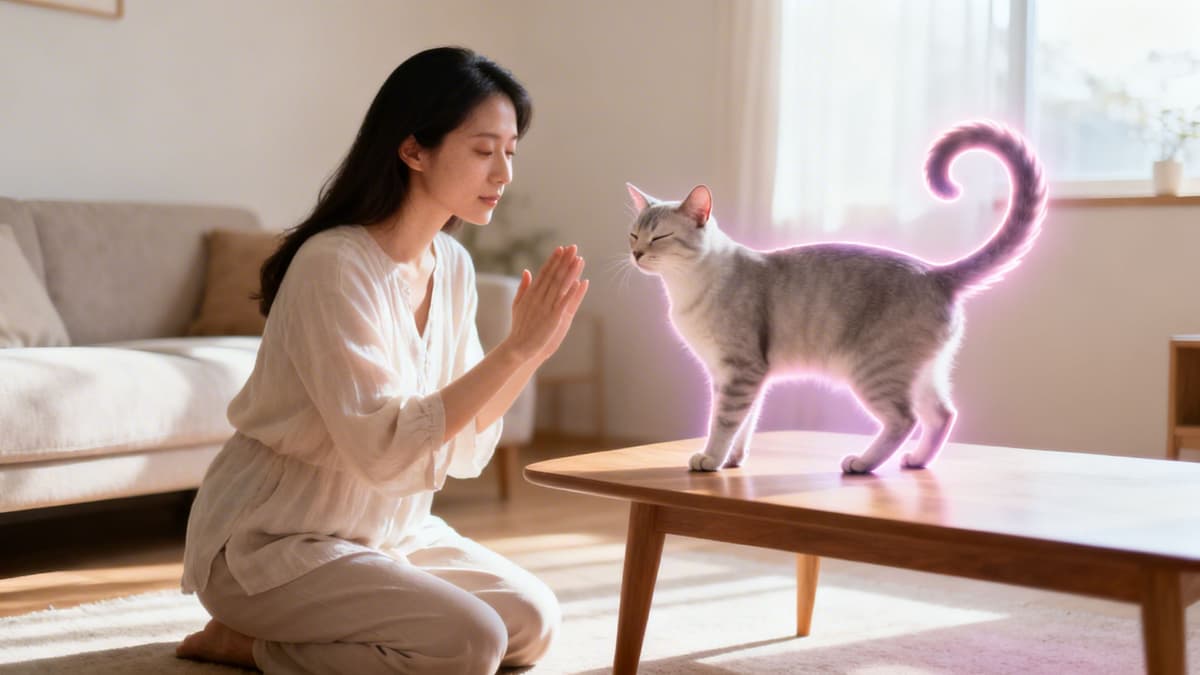
After 27 years of communicating with animals as a pet psychic, what I tell pet parents is this: your cat is talking to you all the time. To truly understand cat body language, we need to look beyond the meows; it's a silent language spoken through the flick of an ear, the curve of their tail, or the way they hold their body. In my experience, learning to read these signals is the first, most beautiful step toward a profoundly deeper connection. This is the part I love most about my work.
What Have I Learned from 27 Years of Listening to Cats?
One of the first things I share with clients is how to tune into their cat's physical cues. Think about it this way: their body is a living, breathing billboard for their emotions. I've found that these aren’t just random twitches or quirky habits. Every movement is a deliberate message, a piece of a conversation they’re having with you.
We're going to pull back the curtain on this secret language. Forget guesswork; you'll soon understand:
- What a confident, high tail is really saying about your relationship.
- Why their ears are such an honest window into their true feelings.
- How to interpret those meaningful, gentle slow blinks.
It all starts with observation. This decision tree is a wonderful starting point for watching the three most important communicators: the tail, ears, and eyes.

Just by focusing on these three areas, you can get an immediate, surprisingly accurate read on your cat's emotional state. Trust me, once you start looking, you won't be able to stop seeing the rich, complex world of your cat's inner life. You'll stop just seeing your cat and start truly understanding them.
Here's a quick reference guide to decoding the most common signals your cat sends, so you can respond with confidence and love.
Your Cat's Quick Communication Signals
| Signal | What It Often Means | Margaret's Advice |
|---|---|---|
| Tail Straight Up | Happiness, confidence, or excitement to see you. A friendly greeting! | This is a perfect time for gentle pets or offering a treat. They are open and receptive to you. |
| Ears Forward | Alertness, curiosity, and interest. They are focused on something. | Engage them with a toy or speak to them in a calm voice. They are ready for positive interaction. |
| Slow Blinks | A sign of trust and affection. This is the famous "cat kiss." | Slowly blink back! This shows you understand and return their affection, strengthening your bond. |
| Tail Tucked | Fear, anxiety, or submission. They feel threatened or insecure. | Don't force interaction. Give them space and create a safe, quiet environment. Speak softly. |
| Hissing or Growling | A clear warning. The cat is feeling threatened, angry, or scared. | Back away slowly and remove the source of their stress if possible. This is a "leave me alone" signal. |
Once you get the hang of these, you'll find the conversations flow more easily, and your cat will feel more seen and heard.
Going Beyond Body Language
Of course, their silent language is only part of the story. Beyond the purrs and postures, cats use a surprising range of vocalizations to communicate. Learning what their meows are actually saying adds another rich layer to your understanding. Here's what truly amazes me: seeing that connection finally click into place for someone.
In my experience, once you begin to truly listen with your eyes and your heart, the conversations never stop. If you're curious about how this deep listening works on an intuitive level, you can learn more about telepathy with animals and explore your own innate connection.
Why Are Your Cat's Ears Such a Critical Clue?
After 27 years of connecting with animals, I can tell you that a cat's ears are one of the most honest parts of their body. They are like little emotional radar dishes, broadcasting exactly how your cat is feeling long before their tail or voice gets the memo. It’s so easy to miss the subtle flicks and rotations, but that’s where the real story is.
Think about this: a cat has more than 30 muscles in each ear, all designed for incredibly tiny, precise movements. I know that might surprise you, but they aren't just for hearing, they're for expressing. Learning to read those signals is a huge step in understanding what your cat is trying to tell you.
I remember working with a client whose cat, Leo, always seemed to have his ears flattened. The owner just figured he was a "grumpy" cat. But when I connected with Leo, he showed me this feeling of intense anxiety. It turned out a new neighborhood cat was visible from the window, and Leo felt threatened. Those flattened ears weren't anger, they were a clear sign of fear.

What Are the Main Ear Positions to Watch For?
So, what should you be looking for? Time and time again, I see the same key positions that tell you almost everything you need to know. Once you start looking, you'll spot these three main states easily.
- Forward and Upright: This is your classic "curiosity" mode. When their ears are pointed up and slightly forward, they are alert, interested, and tuned in to their surroundings. It’s the look of a confident, relaxed cat who is engaged with the world.
- Turned Sideways (Airplane Ears): Pay attention to this one. As the ears start to rotate outwards and flatten, it’s a sign of growing irritation or annoyance. Put simply, your cat is saying, "I'm not enjoying this." It's a clear warning shot telling you, or whatever is bothering them, to back off.
- Flattened Back Against the Head: This is a big one. When the ears are pinned flat against the skull, you're seeing a major signal of fear, anxiety, or defensiveness. A cat does this to protect their ears from claws and teeth in case a fight breaks out. This is a cat who feels seriously threatened and is preparing for the worst.
It’s not just anecdotal, either. Science is finally confirming what pet communicators and observant owners have known for decades. A 2021 study highlighted just how predictive ear position is in cat interactions. Researchers found that when two cats met with their ears held upright and forward, the interactions were overwhelmingly positive, think friendly head rubs and bonding. You can see the details of how these signals work in the full study.
The wonderful news is, once you know what to look for, you can’t unsee it. You're starting to hear the quiet parts of your cat's conversation. This is where the connection gets really meaningful, and it's the part of my work I love most.
How Can You Read the Story Your Cat's Tail Is Telling?
If you’ve ever watched a cat, you know their tail is rarely still. It’s a beautiful, expressive antenna broadcasting their every mood, but it’s easy to misinterpret. After 27 years of helping people understand their animals, I can tell you that a cat’s tail tells a far more complex story than a dog’s happy wag.
Learning to read it is one of the most direct ways to understand what your cat is feeling moment to moment. It's a skill that moves you from simply cohabiting to truly communicating.

What Do Different Tail Positions Actually Mean?
Let's break down some of the most common signals I see in my sessions. Think of these as the core vocabulary for your cat's tail. Once you know them, you'll start seeing them everywhere.
- Tail Held High and Straight: This is the ultimate sign of confidence and happiness. When you come home and your cat trots toward you with their tail pointing to the sky, that’s their version of a warm, open-hearted "Hello! I'm so glad to see you!"
- The Question Mark Tail: A tail held high with a distinct curve at the tip is a tell-tale sign of a friendly, inquisitive mood. This is a cat who is feeling playful and open to interaction. It’s a green light for a gentle pet or a bit of playtime.
- Tail Tucked Low or Between the Legs: This posture signals fear, anxiety, or submission. A cat with a tucked tail is feeling overwhelmed and trying to make themselves smaller, hoping not to be noticed. It's a clear plea for space and a sign of deep insecurity.
- The Puffed-Up "Halloween" Tail: This is pure, instinctive defense. When a cat is startled or feels threatened, they’ll fluff up their tail (and often the fur along their spine) to appear much larger and more intimidating. This is an unmistakable warning that says, "Back off now!"
It’s just incredible how effectively cats use their bodies to communicate their boundaries. They are absolute masters of non-verbal dialogue.
What that really means is you're not just looking at a tail. You're reading a direct, honest emotional statement from your pet. Acknowledging it is the first step to a deeper dialogue.
How Do You Understand Tail Movements?
I once worked with a client who was completely baffled by her cat, Mittens. She'd watch Mittens thrash her tail back and forth and assume it was a sign of excitement. But every time she’d reach out to play, Mittens would swat her hand.
Here's the distinction I explained to her:
In that context, the fast, lashing tail was the opposite of an invitation. It meant, "I'm getting agitated and overstimulated, and I need you to stop." A rapid, twitching or whipping tail almost always signals growing irritation or conflict. It’s a build-up of energy that can easily spill over into a scratch or a hiss.
A slow, gentle swish, on the other hand, usually indicates focus, like when they're mesmerized by a bird outside the window. And that tiny, almost imperceptible flick at the tip of the tail? That can be a quiet acknowledgment of your presence, a sign of contentment even as they appear to be dozing.
By paying attention to these subtle differences, you can stop guessing and start having a real conversation with your cat, responding to what they’re actually trying to tell you.
What Are Your Cat's 276 Facial Expressions Actually Saying?
It’s one of my favorite things to talk about. For so long, we’ve labeled cats as mysterious or emotionally distant. But in my sessions, I’ve always seen this incredibly rich, silent language playing out across their faces: a constant stream of micro-expressions. I find this absolutely fascinating. And finally, the science is catching up.

Here's another way to look at it: a subtle whisker twitch paired with a slow blink is a world away from that same twitch combined with wide, staring eyes. One is a soft, gentle "hello," while the other can be a sign of high alert or fear. The wonderful news is, you don’t need to be an animal psychic to start seeing these nuances.
What I've witnessed in my practice for decades was recently backed up by a groundbreaking 2023 study. Researchers identified an incredible 276 distinct facial expressions cats use to communicate, all built from 26 individual muscle movements like ear flicks, nose licks, and whisker shifts. You can discover more about these fascinating findings and see for yourself just how much our cats are saying.
How Do You Read Beyond the "Blank Stare"?
I remember a reading with a cat named Jasper whose human was worried he was aloof and just didn't connect with her. He just gave her this "blank stare," she said. When I connected with him, Jasper showed me an image of his face but directed all my attention to his whiskers. They were pulled back tight, almost plastered against his cheeks. He was hiding his eyes and ears from me, forcing me to see only that one signal.
Here's the thing: this wasn't aloofness; it was the clearest way he knew how to show his discomfort. That tight-whisker "stare" was his sign for the chronic pain he felt from a bad tooth. It’s a perfect example of something I see all the time: our animals are always communicating. Sometimes we just aren't looking for the right signals.
How Do You Decode Your Cat’s Face?
So, what should you actually look for? The key is to stop focusing on just one feature and start seeing how they all work together. Think of it as learning the individual words to understand the full sentence.
Here are the most important elements to watch:
- Eyes: Are they soft and offering slow blinks? That's a classic sign of trust, often called a "kitty kiss." Or are they wide and unblinking, signaling fear or high alert? Pupil size is also a huge tell. Dilated pupils can mean excitement or fear, while narrow slits can mean contentment or, in another context, irritation.
- Whiskers: Relaxed whiskers fanning out to the side mean your cat is calm. If they’re bunched forward, they’re curious or hunting something. But if they're pulled back flat against the face like Jasper's were, that’s a big red flag for fear or pain.
- Mouth and Muzzle: A closed, relaxed mouth is a sign of a content cat. Pay close attention to any tension in the muzzle, which is a subtle but powerful indicator of stress.
This is where things get deeply interesting. When you combine these facial cues with the position of their ears and tail, you get the whole story. You move past the guesswork and start having a real conversation.
Are You Misreading These Common Cat Signals?
If you've ever felt like you and your cat are speaking completely different languages, you're not alone in feeling this. It's incredibly common to get wires crossed. What I'm seeing with more and more animals lately is a lot of confusion around a cat’s “freeze” response. A loving owner sees their cat go completely still and thinks they're just being calm or even a bit stubborn.
But from the cat's perspective, it's the exact opposite. Let me explain. They aren't just being still, they are internally screaming, "I'm terrified!"
One of the biggest misinterpretations I see time and again involves the belly. A cat rolls over, exposes that fluffy tummy, and we humans instinctively reach down for a good belly rub. While sometimes this is an invitation for affection, more often it’s a gesture of profound trust paired with a defensive posture.
It’s your cat’s way of saying, “I trust you enough not to hurt me, but all four of my clawed feet are armed and ready just in case.” This often ends with a sudden scratch, leaving you confused and your cat feeling like their trust was betrayed.
Throughout my twenty-seven years of communicating with animals, I've found this gap in understanding is where so many behavioral problems start. This isn't surprising, as research shows people misread their cat’s signals almost a third of the time, especially when it comes to negative feelings like stress or fear. This is actually a beautiful sign because it means we’re great at recognizing when our cats are happy, but we have room to grow in understanding their discomfort. You can read more about how this communication gap is being studied to see just how common these mix-ups are.
What Should You Actually Do When You See These Signals?
Let’s break down the signals that most often get misinterpreted and what’s really going on in your cat’s mind. Here's what I've noticed with animals over and over.
- The Belly Exposure: Instead of diving in for a rub, try a slow blink from a distance or speak softly. This acknowledges their trust without invading their personal space. Let them be the one to initiate physical contact.
- The Freeze: If your cat suddenly becomes rigid, especially in a new or noisy environment, don't approach. They are completely overwhelmed. The best response is to identify the source of the stress and remove it, or gently guide them to a quiet, safe space. We explore this more in our article about why cats hide and what it means.
- Sudden Grooming: When a cat abruptly starts licking themselves in the middle of an interaction, it's not usually about cleanliness. This is a classic displacement behavior, a way to cope with anxiety or internal conflict. In everyday terms, it's their way of saying, "I'm feeling a little awkward and overwhelmed right now."
What I'd Tell a Friend About Their Cat's Language
If a friend asked me for my single most important piece of advice on understanding their cat, I’d tell them this: context is everything. After all these years, I’ve seen how much we humans crave simple, A-to-B dictionaries, but that’s just not how animals talk.
Take the purr, for instance. It doesn’t always mean your cat is blissfully happy. I've connected with so many cats who purr to self-soothe when they're in pain or feeling scared. It's a lot like how a person might hum quietly to calm their own nerves. By the way, I've confirmed this directly with hundreds of animals in my practice.
How Do You Become a Loving Detective?
In my 27 years of experience, I’ve found the real magic happens when people stop searching for a rigid formula ('tail up = happy') and start observing the entire scene. This is where you get to build a real, personal connection with your cat.
I always encourage my clients to become loving detectives.
- Notice what was going on in the room right before their ears flattened.
- Listen for any specific sounds in the environment when their tail starts to twitch.
- Pay attention to which person or animal they were looking at when their body suddenly went rigid.
This shift in focus is what moves you beyond just translating signals and into a place of true, empathetic understanding. You’re no longer just decoding a message; you're feeling the story behind it.
It's all about looking for the combination of signals. A slow blink is a wonderful sign of trust, but if it comes with a tense body and pinned-back ears, it’s probably not the best time to go in for a cuddle.
Think of it like piecing together a puzzle. Every part of their body, from the flick of an ear to the tip of their tail, is a clue. When you put all those clues together with what's happening around them, the real message becomes clear. That’s when you truly start to appreciate just how complex and rich their communication really is.
If you’re excited to go deeper with this, there are some incredible resources available. I often recommend exploring some of the best books on animal communication to help guide you on this journey.
Frequently Asked Questions
Why does my cat stare at me without blinking?
In my experience, an unblinking stare is a sign of intense focus as your cat is processing information. They're trying to figure something out, like what you might do next or what a strange sound is. The key is to look at their whole body. If their posture is tense, it’s likely driven by fear or anxiety. But if their body is relaxed, it's often just pure, unfiltered curiosity. It's a powerful signal, so it pays to look at the rest of their body language to get the full story.
Is it true that a purr can be a bad sign?
Yes, absolutely. This surprises a lot of people, but it’s a crucial piece of the puzzle. While we all love the deep rumble of a happy cat, I've connected with countless animals who purr to self-soothe when they are in pain or scared, like on a vet's table. You have to be a loving detective and look at the whole picture. A purr while cuddling is contentment, but a purr while hiding or acting strangely is a signal of distress and a call for comfort.
Why does my cat knead me with their paws?
This is my favorite one to explain because the reason is so heartwarming. Kneading, or "making biscuits," is an instinct from kittenhood, when they would knead their mother to stimulate milk flow, a time of ultimate comfort and safety. When your adult cat kneads you, they are giving you the highest compliment possible. They are telling you that you are their source of security and love. It’s a beautiful, tangible expression of your deep bond.
Do you ever wish you could just ask your cat what they're thinking? PetPsychic.com can help. We provide written readings that translate your pet's feelings into words, helping you understand their true needs and deepen your bond. Get the clarity you've been looking for.

Find out what your pet is really trying to tell you
Understand the reason behind the behavior, in your pet’s own words, in a personalized reading delivered within 24-48 hours.
Get My Pet's Reading Get My Pet's Reading
Delivered within 24-48 hours · Double Reading Guarantee